

4 Strategies to Grow Your Financial Advisory Business



Finish the Year Strong!
One of my favorite sayings is, "Dig your well before you're thirsty." I've used that expression with financial advisors for years because it applies so well to this business. As an advisor, you spend your career encouraging clients to prepare before they need to. You help them plan for retirement before retirement arrives, manage risk before something happens, and build wealth slowly and consistently because you understand the power of compounding. But I sometimes ask advisors a very simple question: do you manage your own business with the same mindset?
If you want to have a tremendous start to the next year, the best time to create that momentum is not after the calendar turns. It is now.
Over the years, I've spoken with countless advisors who reach the final stretch of the year and almost unconsciously begin taking their foot off the gas. There are holidays coming, calendars get complicated, clients travel, team members take vacation, and everyone starts talking about what they are going to do "next year." I understand it. But I would encourage you to look at this period differently.
The final stretch of the year can be one of the most valuable periods in your entire business. Not because I'm suggesting you work longer hours or cram more meetings into an already busy calendar. Quite the opposite. I want you to become more focused. There are a handful of simple things you can do right now that can strengthen your best client relationships, reinforce your value, increase advocacy and position your business beautifully for what comes next.
At Pareto Systems, we describe this as finishing strong. The objective is really threefold. We want to help you competitor-proof your most important relationships, create greater confidence and empowerment among your clients, and increase the potential for advocacy. The good news is that none of this requires reinventing the wheel. In fact, I would argue that this is one of those times when you absolutely should not reinvent the wheel.
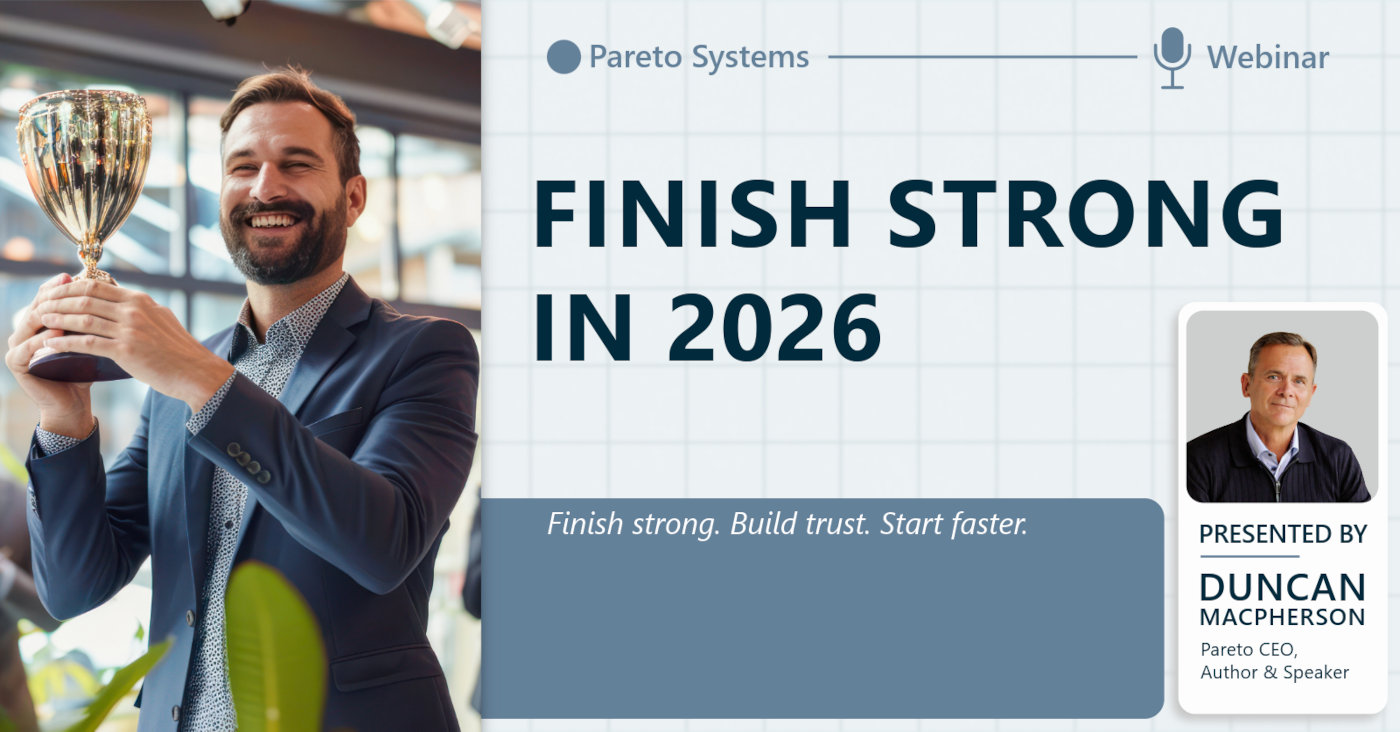
Register for the Finish Strong Webinar
How to Strengthen Your Practice by Focusing on What You Can Control
One thing I've noticed in conversations with advisors is how easy it is to become distracted by things outside our control. Markets, interest rates, politics, technology, headlines, economic predictions and the latest marketing idea someone is promoting online can all compete for our attention. There is always something. And there can be a tendency to think, "Once things settle down, then I'll really focus on growing the business."
But when exactly do things settle down? They don't.
There will always be uncertainty. There will always be noise. So rather than worrying about things you cannot control, I encourage advisors to become almost obsessive about the things they can control. You can control how frequently you communicate with your best clients. You can control the quality of the client experience you provide. You can control whether clients feel appreciated. You can control whether you and your team are proactive. And you can control whether your best clients clearly understand what makes you different.
Those things matter because you never know when a referable moment is going to occur.

How Financial Advisors Can Strengthen Client Relationships and Generate More Referrals
Imagine one of your best clients is having dinner with friends. Someone at the table mentions that they are frustrated with their advisor. Maybe communication has become inconsistent. Maybe they are approaching retirement and are not sure whether they have a real plan. Maybe they recently sold a business, experienced a critical life event or simply feel unsettled by the markets. Your client is sitting right there. That is a referable moment.
The question is whether your client will be ready.
Will they immediately think of you? Will they know how to describe what you do? Will they be able to articulate why their experience with you is different? A satisfied client is not automatically an effective advocate. You can have an incredibly loyal client who thinks the world of you, but when somebody asks, "What does your advisor do for you?" they may still answer, "He manages our investments."
You and I both know you probably do considerably more than that.
One of our responsibilities, therefore, is to continually help clients understand the full value of the relationship. Not by bragging and not by constantly asking for referrals, but by creating a client experience that is so consistent and communicative that your value becomes unmistakable.
Strategy 1: Strengthen Client Relationships With a 90-Day Call Rotation
The first strategy is the call rotation. I am a huge believer in call rotations, and I want to emphasize something right away: these are not sales calls. You are not calling because you need something. You are not calling because there is a product to discuss. You are not even necessarily calling because there is an investment issue. You are calling because you care about the relationship.
Start by identifying approximately 50 to 100 of your most important client relationships and organize those clients into a simple 90-day call rotation. Then call them.
"I was thinking about you and wanted to check in. How are things going?"
Then listen.
You would be amazed by what comes out of those conversations. This is something I've seen repeatedly with great advisors. Once you remove the formal meeting agenda and simply have a conversation, clients start telling you what is actually happening in their lives. A child is getting married. Someone is considering retirement. A parent is struggling. They are renovating the house. They are thinking about selling the family business. They have booked a trip they have wanted to take for twenty years. They have become grandparents. They are worried about one of their children.
Those details matter, and they give you the opportunity to understand the client at a much deeper level.
Use F.O.R.M. to Personalize Financial Advisor-Client Conversations
If you have worked with Pareto Systems for any length of time, you have probably heard us talk about F.O.R.M.: Family, Occupation, Recreation and Money. I like F.O.R.M. because it gives advisors structure without making the conversation feel scripted. You might ask what is happening with the client's family, what is changing professionally, what they are doing for fun, or what financial issues are on their mind. You are not trying to force four categories into every conversation. The purpose is simply to become more prepared and more curious.
Before you call an important client, take a moment and ask yourself what you know about that person right now. If you know they were planning a family trip, ask about the trip. If their daughter recently graduated, ask how she is doing. If they told you six months ago that they wanted to retire soon, ask how they are feeling about that decision now.
I often remind advisors that personalization is not about saying a client's name more frequently. It is about remembering what matters to them.
How Proactive Client Communication Strengthens Relationships
There is another important benefit to the call rotation. It changes the nature of the relationship from reactive to proactive. Think about how many advisor-client interactions are triggered by something. The client needs money. The market declines. A statement arrives. A document needs signing. A meeting needs scheduling. Those interactions are necessary, but they reinforce the idea that communication happens because something needs to happen.
A proactive call sends a very different message: there is nothing wrong, I do not need anything from you, I was simply thinking about you.
That has impact. And when you do it consistently, it begins to competitor-proof the relationship because you are not giving another advisor an opening to be more attentive than you are.
Strategy 2: Strengthen Client Relationships With a Financial Advisor Client Appreciation Strategy
The second strategy is one of the simplest things you can do: send your best clients a Thanksgiving card. Many advisors already send holiday cards, and that is perfectly fine. But almost everyone else does too. That is why a Thanksgiving card can stand out. It arrives at a different time, it is unexpected, and the message does not need to be complicated. You are simply saying thank you.
Thank you for your trust. Thank you for the relationship. Thank you for allowing us to be part of your life.
There is something refreshing about that. No market commentary. No call to action. No product. No sales message. Just gratitude.

How to Make Client Communications More Memorable
I also want you to think about something I call shelf life. Let's face it: people sort through a lot of mail standing over a recycling bin. So if you are going to send a card, make it good. Make it memorable. Use a beautiful image, quality materials and a personal touch. Create something that your client might actually leave sitting on a counter, bookshelf or desk for a few weeks.
I recommend using Lavish Cards. You can view their website here.
Why does that matter? Because every time they see it, there is a subtle reminder of the relationship. Again, you are staying top of mind without having to constantly promote yourself.
The message itself can be incredibly simple:
"We would like to wish you and your family all the best for the Thanksgiving holiday. We'd also like to thank you for a great relationship."

How Client Appreciation Builds Advocacy and Referrals for Financial Advisors
I would also encourage you not to think of this transactionally. Do not send a thoughtful card because you hope it will immediately produce a referral. Show appreciation because you genuinely appreciate the relationship. When that becomes part of your culture, reciprocity tends to happen naturally.
Clients become more engaged, more responsive and more enthusiastic about the relationship. When a friend eventually says, "I'm thinking about changing advisors," your client is much more likely to speak passionately about you.
You did not manufacture the referral. You created the conditions for advocacy.
Strategy 3: Build Stronger Client Relationships With a Financial Advisor Holiday Letter
The third strategy is a personal holiday letter, and I want to make an important distinction here. This should not be another market letter.
Your clients already receive enough information. They can find economic forecasts everywhere. They can turn on television, open an app or read twenty opinions before breakfast. What they do not have access to everywhere is you. Your perspective. What you learned. How you are thinking about the future. What has happened with your team. What you are grateful for. What your family is doing during the holidays.
That is what makes this letter valuable.
I often tell advisors to put more emphasis on the messenger than the message.
Your clients have trusted you with very personal parts of their lives. You know about their money, their family, their concerns, their dreams, their retirement, their children, their businesses and their estate plans. It is entirely appropriate to occasionally allow them to know a little more about you.
That does not mean oversharing. It simply means being human.
Tell them you are hosting the family for dinner. Tell them you are heading to the mountains. Tell them you will be spending a few quiet days at home playing board games with the kids. Those details create connection, and connection strengthens relationships.

Holiday Letter Template for Building Stronger Client Relationships
Here is the Holiday Letter Template as provided:
Wishing You a Joyful Holiday Season!
Dear [Client's Name],
As the year comes to a close, I find myself reflecting on the lessons of the past twelve months and how they will shape the year ahead. More than numbers or markets, what stands out most is the importance of perspective: staying disciplined through uncertainty, focusing on what we can control, and building on the progress we've made together.
One of the most valuable insights I've gained this year is that true wealth is not only measured in dollars, but also in peace of mind, time with loved ones, and the confidence that comes from having a plan. My commitment to you is to carry those lessons forward, ensuring our strategies remain intentional, resilient, and aligned with your goals for the future.
On a personal note, my family and I are looking forward to [insert a detail or two: e.g., "hosting Christmas dinner this year with all the kids home under one roof" / "a quiet holiday getaway at the mountain with some skating and fireside evenings" / "a simple celebration at home, filled with laughter, too much food, and plenty of board games"]. These moments remind me why I do what I do, to help families like yours create the freedom to enjoy life's most meaningful experiences.
As always, I am grateful for the trust you place in me. Working with you and being part of your journey is truly one of the highlights of my year.
On behalf of myself and my family, I wish you and yours a joyous holiday season and a prosperous New Year.
Warm regards,
Signature
[Your Name]
[Your Title/Company]
How Financial Advisors Can Stay Top of Mind and Create More Referral Opportunities
The reason I like putting these first three strategies together during this part of the year is simple: your clients are going to be spending time with people. Lots of people. Family dinners, holiday parties, business events, vacations and social gatherings create more opportunities for conversations with friends and family. And eventually, somebody is going to talk about money.
Someone is retiring. Someone is frustrated with their advisor. Someone received an inheritance. Someone is selling a business. Someone is worried about the markets. Someone says, "We really need to get more organized financially."
And there is your client.
Think about the sequence you have just created. You called them. You asked about their family. You remembered what was happening in their life. You sent them a Thanksgiving card. You thanked them for the relationship. Then you sent a holiday letter that reinforced your perspective, values and commitment.
You are now very much top of mind.
So when that referable moment occurs, your client does not have to search their memory for your name. The response can become instinctive: "You should talk to my advisor."
That is what we want.
Strategy 4: Identify Practice Management Gaps in Your Business
The fourth strategy turns the mirror back on your own business.
At some point, every advisor should ask a simple question: where are the biggest opportunities to improve my practice?
This is harder than it sounds. I have met tremendously successful advisors who know there are things that need improvement, but they have not clearly identified which issues deserve attention first. They might say, "We need better systems," or "Our team needs more structure," or "We could do a better job with referrals," or "We need to improve the client experience."
All of those things might be true. But when everything is a priority, nothing is a priority.
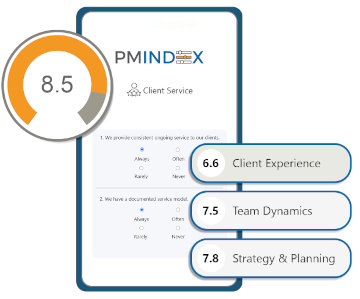
That is exactly why I believe in the Practice Management Index Assessment.

Use the Practice Management Index to Assess and Improve Practice Management
The PMI allows you to step back and assess your practice across 18 different focus areas. You complete the assessment, download your score and report, and then study the gaps.
You do not need to fix everything. In fact, please do not try.
Identify the areas where improvement would create the greatest ripple effect across the business. That is where your energy should go.
Financial Advisor Practice Management: Why Clarity Comes Before Activity
One of the most important coaching lessons I can give an advisor is this: clarity before activity.
A lot of people are busy. Busy does not necessarily mean productive. You can fill every hour of the day and still avoid the handful of things that would actually move the business forward.
The purpose of an assessment is to create clarity. Where are we strong? Where are we inconsistent? Where are we vulnerable? Where are we relying too much on one person? Where has the business outgrown the process? Where could a small improvement create a significant result?
Those are much better questions than, "What else should I be doing?"
Very often, you do not need more things to do. You need to become better at the right things.
Why Consistency Is Essential for Financial Advisor Business Growth and Client Retention
There is a common thread running through all four of these strategies. None of them is particularly complicated, and that is intentional. One of the biggest mistakes I see advisors make is constantly searching for something new: a new marketing strategy, a new technology platform, a new campaign, a new tactic, a new idea.
Sometimes new is necessary. But frequently the greatest opportunity is simply to execute proven fundamentals more consistently.
Call your clients. Listen. Remember what is important to them. Thank them. Share something personal. Help them understand your value. Assess your business. Identify your gaps. Improve. Then do it again.
And remember, you do not have to wait until next year to have a great start to the year. Finish this one strong first.
For more practice management strategies, resources and coaching for financial advisors, visit paretosystems.com.